Key takeaways
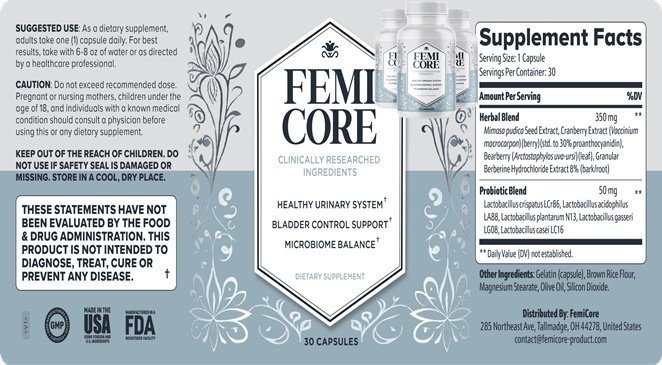
- FemiCore lists nine active ingredients: five Lactobacillus strains and four botanicals (cranberry, bearberry, berberine and Mimosa pudica).
- Most of the supporting research looks at single ingredients, not at FemiCore as a finished product.
- The label does not make it easy to confirm every dose or the probiotic count at expiry, so it is worth checking before you buy.
- Bearberry and berberine are the two ingredients that deserve the most attention for safety and drug interactions.
FemiCore Ingredients at a Glance
FemiCore is built around one idea: that the bladder, urinary tract and vagina share a community of bacteria, and that supporting it can help with everyday bladder comfort. To do that, the formula pairs probiotics with botanicals that have a long history in urinary health. If you are new to the product, our complete FemiCore review covers the basics first.
| Ingredient | Type | Main reason it's included | Strength of evidence |
|---|---|---|---|
| Lactobacillus crispatus | Probiotic | Vaginal flora and natural acidity | Moderate, mostly vaginal-health studies |
| Lactobacillus acidophilus | Probiotic | Gut and urogenital flora | Mixed |
| Lactobacillus plantarum | Probiotic | Survives stomach acid well | Mostly digestive research |
| Lactobacillus gasseri | Probiotic | Vaginal tissue colonization | Limited to moderate |
| Lactobacillus casei | Probiotic | Flora diversity and digestion | Mostly digestive research |
| Cranberry extract (PACs) | Botanical | Urinary tract support | The most studied ingredient here |
| Bearberry leaf (uva ursi) | Botanical | Traditional urinary comfort | Limited; short-term use only |
| Berberine | Botanical | Bladder comfort support | Early, mostly lab and animal |
| Mimosa pudica seed | Botanical | Gut environment support | Preliminary |
The Five Lactobacillus Probiotic Strains
Lactobacillus bacteria produce lactic acid, which helps keep the vaginal environment naturally acidic. Research over the past decade has also shown that urine is not sterile, as was once assumed, and that Lactobacillus species are often found in the urinary tract of healthy women. That is the scientific backdrop for including them in a bladder supplement.
One important point: benefits of probiotics are strain-specific. Two products can both list "L. crispatus" but contain different strains with different research behind them. If the label only lists species names without strain codes, you cannot match it to specific studies.
Lactobacillus crispatus
This is the headline strain. L. crispatus is one of the most common bacteria in a healthy vaginal microbiome and is strongly associated with a stable, acidic environment. Several studies have looked at L. crispatus given as a vaginal suppository. Evidence for oral capsules reaching the vagina in meaningful numbers is less consistent, which is worth keeping in mind.
Lactobacillus acidophilus
One of the most familiar probiotics, found in yogurt and countless supplements. It is included mainly for gut flora support. Researchers describe a "gut–vaginal axis", meaning bacteria from the gut can influence the vaginal and urinary environment, which is why a gut-focused strain appears in a bladder formula.
Lactobacillus plantarum
L. plantarum is known for tolerating stomach acid better than many strains, so more live bacteria are likely to reach the intestines. Most of its research relates to digestive comfort rather than bladder health specifically.
Lactobacillus gasseri
Naturally found in both the vaginal and digestive tracts. It has been studied for its ability to adhere to vaginal tissue and for its role alongside L. crispatus in keeping flora balanced.
Lactobacillus casei
Another common strain, mostly studied for digestion and general immune support. In FemiCore it adds diversity to the blend rather than targeting the bladder directly.
The Four Botanical Ingredients
Cranberry extract (PACs)
Cranberry is the best-researched natural ingredient for urinary tract health. Its proanthocyanidins, or PACs, appear to make it harder for certain bacteria to attach to the lining of the urinary tract. Large research reviews have found cranberry products may help some groups, particularly women with a history of recurrent urinary issues, while results vary with the type of product and the amount of PACs it delivers. That is why the dose matters: a small sprinkle of cranberry powder is not the same as a standardized PAC extract.
Bearberry leaf (uva ursi)
Bearberry has been used in traditional herbal medicine for urinary comfort for centuries. It contains arbutin, which the body converts into compounds with antibacterial activity in the urine. Because one of those compounds, hydroquinone, raises safety questions with prolonged use, European herbal monographs generally limit bearberry to short courses and advise against it during pregnancy, breastfeeding, in children, and in people with kidney disease. This is the ingredient to ask your doctor about if you plan to take FemiCore for many months. Our FemiCore side effects guide covers this in more detail.
Berberine
Berberine is a yellow plant compound found in goldenseal, barberry and other herbs. It is popular for blood sugar support and has been studied in the lab for effects on bladder muscle activity. Human data on bladder symptoms specifically is limited. Berberine can interact with several medications, including diabetes drugs, blood pressure medicines and drugs processed by certain liver enzymes, so anyone taking prescriptions should check with a pharmacist.
Mimosa pudica seed
Used in traditional Ayurvedic practice for digestive health. In FemiCore it is positioned as gut support, helping create conditions where probiotics can thrive. Research on Mimosa pudica in humans is preliminary, so treat this as a supporting ingredient rather than a key active.
What the Label Doesn't Tell You
A good ingredient list is only half the picture. Before buying, look at the Supplement Facts panel (shown above) and check for the following:
- Individual doses. Are the amounts of cranberry PACs, bearberry and berberine listed separately, or grouped into a single blend weight?
- Probiotic count. Is the CFU (colony-forming unit) number stated, and is it guaranteed "at time of manufacture" or "through expiration"? The second is more meaningful.
- Strain codes. Are specific strain identifiers listed, or only species names?
- Storage. Does the product need refrigeration? Heat can reduce probiotic counts during shipping.
- Other ingredients. Capsule material, fillers and potential allergens.
Our take: We could not find a full, independently published dose breakdown for FemiCore. That is common for direct-to-consumer supplements and not proof of a problem, but it does make it harder to compare the formula with the doses used in research. If this matters to you, email the seller and ask for the complete Supplement Facts before ordering.
How the Ingredients Are Meant to Work Together
The design logic is a two-layer approach. The botanicals, especially cranberry PACs, are meant to support the urinary tract from the first days of use. The probiotics are a slower, longer-term play, since it takes weeks for supplemental bacteria to have any potential effect on flora. This is why most guidance suggests taking FemiCore consistently for at least two to three months before judging it. Our guide on how to take FemiCore explains timing and consistency in more detail.
Whether this combination produces a noticeable result for you is a separate question. We look at the evidence honestly in does FemiCore work?
Who Should Review the Ingredients With a Doctor
- Anyone who is pregnant, trying to conceive or breastfeeding, mainly because of bearberry and berberine.
- People with kidney or liver conditions.
- Anyone taking prescription medication, especially for diabetes, blood pressure, or blood thinning.
- People with a weakened immune system, for whom probiotics are not always recommended.
- Anyone with current symptoms of a urinary infection, which needs medical assessment rather than a supplement.
FemiCore Ingredients FAQ
Does FemiCore contain cranberry?
Yes. FemiCore includes a cranberry extract that is described as a source of proanthocyanidins (PACs), the compounds most studied for urinary tract support.
How many probiotic strains are in FemiCore?
FemiCore lists five Lactobacillus strains: L. crispatus, L. acidophilus, L. plantarum, L. gasseri and L. casei.
Is FemiCore a proprietary blend?
Check the Supplement Facts panel on your bottle. If ingredients are grouped under a blend with one combined weight, the individual doses are not disclosed. You can ask the seller for a full breakdown before ordering.
Is FemiCore vegan or allergen-free?
The capsule material and inactive ingredients determine this, and they are listed at the bottom of the label. If you have allergies or dietary restrictions, read that section carefully or contact the seller.