FemiCore Ingredients Analysis: Do They Actually Work for Bladder Health?
When evaluating any supplement, the most important question is never “what’s in it?” — it’s “why does it work when everything else hasn’t?” For women who have cycled through antibiotics, cranberry capsules, and prescription medications without lasting relief, the answer requires examining what the combination is designed to accomplish — not just what each ingredient does in isolation.
This analysis examines the FemiCore ingredients through that lens: the clinical basis for each choice, the gaps conventional treatments leave open, and why this nine-ingredient formula represents a structurally different approach to urinary health.
The Problem With How Most Women Treat Bladder Issues
To understand why the FemiCore ingredient profile is significant, it helps to understand what’s missing from the standard toolkit.
Antibiotics eliminate the immediate bacterial threat but cannot distinguish between pathogens and the protective Lactobacillus strains that form the urinary tract’s natural defense. Women who undergo repeated antibiotic courses often emerge with a more vulnerable microbiome than before, explaining why infections return faster over time.
Cranberry supplements and D-Mannose address bacterial adhesion but leave the underlying microbiome imbalance untouched. Prescription OAB medications force a muscular response without addressing the microbial conditions driving hyperactivity. Pelvic floor exercises strengthen physical structure but have no effect on the bacterial ecology governing urinary pH.
What none of these approaches address is the finding published in the American Journal of Obstetrics and Gynecology: women with bladder control issues and recurring infections share a consistent microbiome profile — severely depleted protective Lactobacillus bacteria, unstable urinary pH, and a bacterial environment that actively favors pathogen colonization. Until that ecosystem is restored, every other intervention is downstream management.
The FemiCore ingredients were selected to address that ecosystem directly.
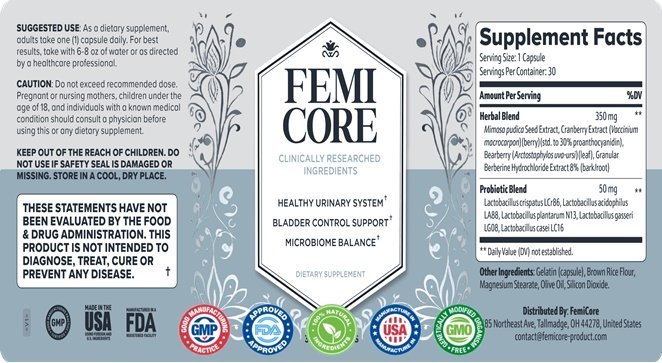
How the Nine FemiCore Ingredients Divide Into Three Functional Layers
The formula isn’t nine parallel components doing similar things. It’s a three-layer system in which each group of ingredients targets a different stage of the urinary defense breakdown.
Layer One: Ecosystem Restoration — the five Lactobacillus probiotic strains rebuild the protective bacterial community that healthy bladder function depends on.
Layer Two: Acute Pathogen Defense — cranberry extract and bearberry create an immediate hostile environment for pathogens, protecting while probiotic colonization establishes over weeks.
Layer Three: Systemic Support — berberine addresses muscular bladder hyperactivity directly, and Mimosa pudica reinforces the gut-vaginal axis that sustains urogenital flora from within.
Understanding this layered architecture explains something that confuses many first-time users: why some effects appear within the first week (the botanical components working acutely) while others take weeks to become noticeable (the probiotic strains establishing stable colonization). This is intentional design, not slow action.
The Five Probiotic Strains: Why These Five and Not Others
The choice of probiotic strains is the most clinically significant decision in the entire formula — and the dimension that most distinguishes FemiCore from generic probiotic products.
✅ Lactobacillus crispatus is the foundational inclusion. Among all Lactobacillus species studied for urinary health, it shows the strongest association with healthy bladder control and is the strain most severely depleted after repeated antibiotic courses. Its dual action — producing both lactic acid for pH maintenance and hydrogen peroxide for direct antimicrobial activity — makes it the most impactful probiotic component available for urinary microbiome restoration.
✅ Lactobacillus acidophilus bridges the gut and urogenital microbiomes through the gut-vaginal axis — the bidirectional pathway through which intestinal flora continuously influences urogenital flora. It also shows independent clinical evidence of reducing E. coli adhesion to urinary tract epithelium, reinforcing the same anti-adhesion mechanism that cranberry PACs achieve through a chemical route.
✅ Lactobacillus plantarum was selected for its exceptional acid tolerance and specific UTI trial data. It survives stomach acid transit at higher rates than comparable species, delivering more viable colonies to colonization sites. A 2022 trial showing reductions in both UTI frequency and severity makes it one of the few strains with outcome evidence in a urinary infection population — not just digestive health.
✅ Lactobacillus gasseri colonizes vaginal epithelial tissue and works synergistically with L. crispatus to maintain the acidic pH range that makes the urinary environment inhospitable to pathogens. It produces its own antimicrobial compounds targeting the anaerobic organisms most commonly associated with bacterial vaginosis and pre-infection urinary dysbiosis.
✅ Lactobacillus casei adds immune modulation and microbiome diversity — properties that determine whether restoration holds under real-world conditions. Stress, dietary shifts, and antibiotics are all potential disruptors. L. casei builds the adaptive immune response and flora diversity that allows the restored microbiome to hold its ground, converting short-term colonization into durable protection.
The Four Botanical Cofactors: What They Add That Probiotics Alone Cannot
The botanical component of FemiCore addresses two limitations inherent to any probiotic-only approach: the time lag before colonization produces consistent protective effects, and the muscular symptom layer that operates independently of microbial conditions.
✅ Cranberry extract standardized for proanthocyanidins (PACs) provides acute anti-adhesion protection. PAC content — not cranberry powder weight — determines efficacy. PACs specifically bind to E. coli’s type 1 fimbriae, the adhesion proteins it uses to anchor to urinary tract walls. Without this anchorage, bacteria cannot colonize regardless of urinary pH. FemiCore’s PAC standardization ensures delivery at the threshold shown in research to produce measurable anti-adhesion effects — a threshold most consumer cranberry products never reach.
✅ Bearberry leaf (Uva Ursi) contributes local antimicrobial activity through arbutin conversion: arbutin metabolizes into hydroquinone within the urinary tract, targeting bacteria at the infection site without disrupting gut or vaginal flora. Clinical data supports its ability to reduce lower urinary tract discomfort and shorten symptomatic episodes — making it a valuable bridge during the weeks before probiotic colonization becomes robust.
✅ Granular berberine occupies a unique position in the formula: it is the only ingredient directly targeting the muscular symptom layer. Bladder urgency and leakage are not solely microbial problems — they involve hyperactivity of the detrusor muscle, the smooth muscle that controls bladder contraction. Research in the Journal of Ethnopharmacology documents berberine’s ability to modulate neurogenic contractile signaling in this muscle, reducing the involuntary contractions that produce urgency episodes. Berberine also has selective antimicrobial properties that support beneficial bacteria while inhibiting pathogens, giving it both symptomatic and microbiome-level roles.
✅ Mimosa pudica seed extract closes the gut-vaginal loop that L. acidophilus begins. While the probiotic supports the gut environment from a microbial standpoint, Mimosa pudica supports intestinal integrity from a structural standpoint — helping create the physical conditions in which beneficial bacteria can establish and sustain themselves throughout the digestive and urogenital systems. Without adequate gut health, even a well-restored urogenital microbiome faces constant downstream pressure that undermines long-term stability.
What the Combination Achieves That Individual Ingredients Don’t
The clearest insight into FemiCore’s mechanism is this: each ingredient addresses a vulnerability the others cannot reach.
Cranberry PACs prevent adhesion but don’t restore the microbiome. The probiotic strains restore the microbiome but take weeks to establish. Berberine reduces urgency but doesn’t address the bacterial environment driving it. Bearberry provides acute antimicrobial support but doesn’t build lasting protection. Mimosa pudica sustains the ecosystem but doesn’t directly combat active pathogens.
Taken individually, each component offers a partial intervention. Together, they form a sequence: the botanicals create an immediate window of protection while probiotic colonization establishes, and as the microbiome stabilizes, the body’s own restored flora assumes the defensive role. The system becomes self-sustaining — something no single ingredient can achieve independently. The 6–8 week timeline for full restoration reflects this biology, not a marketing choice.
Summary: What the Evidence Says
The clinical foundation for the FemiCore ingredient selection draws on research from the American Journal of Obstetrics and Gynecology, the Journal of Ethnopharmacology, and The Lancet Microbe. No component lacks documented relevance to urinary or vaginal microbiome health.
The more meaningful question — whether this specific combination of FemiCore ingredients is well-designed — is answered by the structural logic: five probiotic strains targeting different dimensions of microbiome restoration, two botanicals providing acute anti-pathogen coverage, one compound directly targeting muscular bladder hyperactivity, and one gut-support ingredient sustaining the entire ecosystem.
For women whose bladder issues have resisted conventional treatment, the FemiCore ingredient profile represents a formula designed around the mechanism of urinary microbiome dysfunction — rather than the symptoms it produces.